
The best CRO tools in 2026
The short answer: for most businesses, the best CRO stack in 2026 is Microsoft Clarity (free heatmaps and recordings), Google Analytics 4 (free measurement), and one testing tool matched to your platform — Convert for most sites, Intelligems if you’re on Shopify. That’s $0–$300 a month, and it covers what actually moves conversion rates. Everything else on this list is for specific jobs, bigger traffic, or bigger teams.
One thing to know before you read any “best CRO tools” list, including the ones ranking above this page: every one of them is published by a company that sells one of the tools — and each ranks its own product first. We sell conversion optimization as a service, not software. No tool on this page pays us, there are no affiliate links, and the ones we recommend are simply the ones we’d spend our own clients’ money on. Some of them we already do.
How we evaluated these tools
Three tools on this list — Unbounce, Looker Studio, and Figma — run on our own client accounts every week; those verdicts are first-hand. Everything else is assessed: we checked every vendor’s live pricing page on July 11, 2026, verified this year’s mergers and shutdowns against primary sources, and judged each tool on the question an agency actually asks — would we put a client’s budget on it? Where a verdict isn’t first-hand, we say so. Where a vendor hides pricing, we say that too.
The comparison table
Pricing checked July 11, 2026, from each vendor’s own pricing page. “Free tier” means a real ongoing plan, not a trial.
| Tool | Job | Free tier | Paid entry | Best for |
|---|---|---|---|---|
| Microsoft Clarity | Heatmaps + recordings | Whole product free | — | Everyone; start here |
| Google Analytics 4 | Measurement | Yes | 360 is quote-only | Everyone |
| Looker Studio | Reporting | Yes | Pro $9/user/project/mo | Dashboards on a budget |
| Contentsquare (was Hotjar) | Heatmaps + surveys | 200k sessions/mo | $39/mo annual | Generous free heatmaps |
| FullStory | Session replay | 30k sessions/mo | Quote-only | Product/UX teams |
| Crazy Egg | Heatmaps | No (30-day trial) | $29/mo annual | Simple heatmap reports |
| Lucky Orange | Recordings + chat | Pulled from pricing page | $32/mo annual | Small ecommerce |
| Mouseflow | Recordings + funnels | 500 sessions/mo | $25/mo annual | Form analytics |
| Convert | A/B testing | No (15-day trial) | $299/mo annual | Mid-market testing |
| VWO | A/B testing suite | Being discontinued | ~$314/mo annual | Full-suite testing |
| AB Tasty | Experimentation | No | Quote-only | Enterprise (merging with VWO) |
| Optimizely | Enterprise experimentation | Buried | Quote-only | Enterprise programs |
| Intelligems | Shopify price testing | No | $59/mo annual | Shopify profit testing |
| Shoplift | Shopify A/B testing | No (14-day trial) | $74/mo annual | Shopify theme tests |
| Unbounce | Landing pages + testing | No (14-day trial) | $22/mo annual | Ad landing pages |
| Instapage | Landing pages | No (14-day trial) | $79/mo annual | Ad-to-page mapping |
| Figma | Design | Yes | $16/seat/mo annual | Designing the variants |
What changed in the CRO market this year
If the list you’re reading doesn’t mention these, it was written before the market moved. Hotjar no longer exists as a standalone product — it merged into Contentsquare on July 1, 2025, and hotjar.com’s pricing page now redirects there. VWO and AB Tasty, long the two mid-market rivals, announced a merger in January 2026 under Everstone Capital; they still sell separately, but any list treating them as independent alternatives is dated. Google Optimize has been dead since September 2023, and Google still hasn’t replaced it — its own docs point to third-party tools instead.
The quieter shift is in free tiers. VWO’s free 50,000-user plan is being discontinued, Lucky Orange’s free plan has disappeared from its pricing page, and Optimizely’s free feature-flagging pages now return 404s. Meanwhile the opposite happened elsewhere: FullStory’s free tier jumped to 30,000 sessions a month in August 2025, and Contentsquare’s free plan covers up to 200,000 monthly sessions. The market is splitting into genuinely free entry products and quote-only enterprise suites, with less and less in between.
One more 2026 pattern: every tool now claims AI. Some of it is real — Clarity’s free AI summaries, VWO’s Copilot generating test variations, a wave of funded AI-native entrants. Plenty of it is a chatbot bolted onto last year’s product. We’ve flagged which is which below.
The tools we run on client accounts
These three carry our own work, so the verdicts are first-hand.
Unbounce — landing pages with testing built in
Unbounce is the primary engine for the landing pages we build and the A/B tests we run on them — pages for ad traffic, built and tested without touching a client’s main site. That separation is the point: campaign pages iterate weekly; websites don’t.
Pricing (checked July 2026): from $22/mo billed annually, but A/B testing starts on the Experiment plan at $112/mo annually, metered by visitors with unlimited conversions. That’s a new model — Unbounce dropped its old conversion-capped plans, so most lists still quote prices that no longer exist. No free tier; 14-day trial. One correction to the record: Unbounce merged with Insightly (the CRM) in July 2024 — the product itself didn’t change or rebrand.
Who it’s for: anyone spending on ads without a dedicated dev team for landing pages. Who it isn’t for: testing your existing site’s pages — that’s an A/B testing tool’s job, not a page builder’s.
Looker Studio — the reporting layer
Every client dashboard we ship runs on Looker Studio: ad platform data, analytics, and spend in one live report a client can open any hour of any day. It’s free, it connects natively to Google’s ecosystem, and it removes the “can you send me the numbers?” email from everyone’s life.
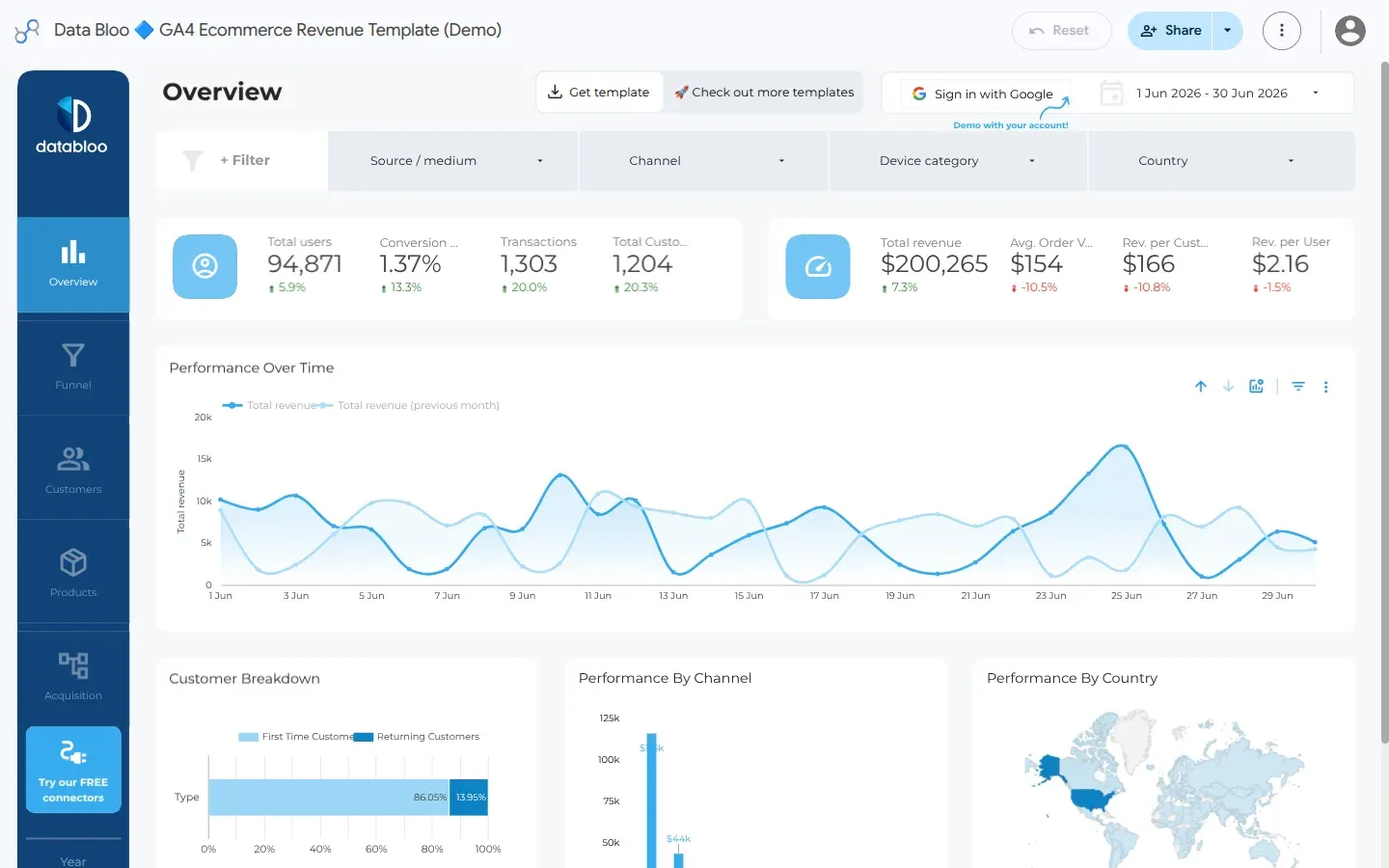
What a Looker Studio ecommerce report looks like — this one is Data Bloo’s public demo template (captured July 12, 2026). Our client dashboards follow the same shape: spend, revenue, and cost per sale, live.
Pricing (checked July 2026): free. Looker Studio Pro is $9 per user per Google Cloud project per month — and note it’s per project, which adds up for agencies running one project per client. The free version is the product; Pro adds team administration.
Figma — where the variants get designed
Every page and test variant we build is designed in Figma before it’s built in Unbounce. For CRO specifically, that order matters: a test is a designed hypothesis, not a color tweak made in a page editor at midnight.
Pricing (checked July 2026): free Starter plan is genuinely usable; paid seats from $16/mo annually on the seat model Figma introduced in March 2025 — older lists quoting per-editor pricing are out of date. AI features are now metered by monthly credits.
Heatmaps and session replay
Watching real sessions is the cheapest research in marketing. Start free here; upgrade only when retention limits actually bite.
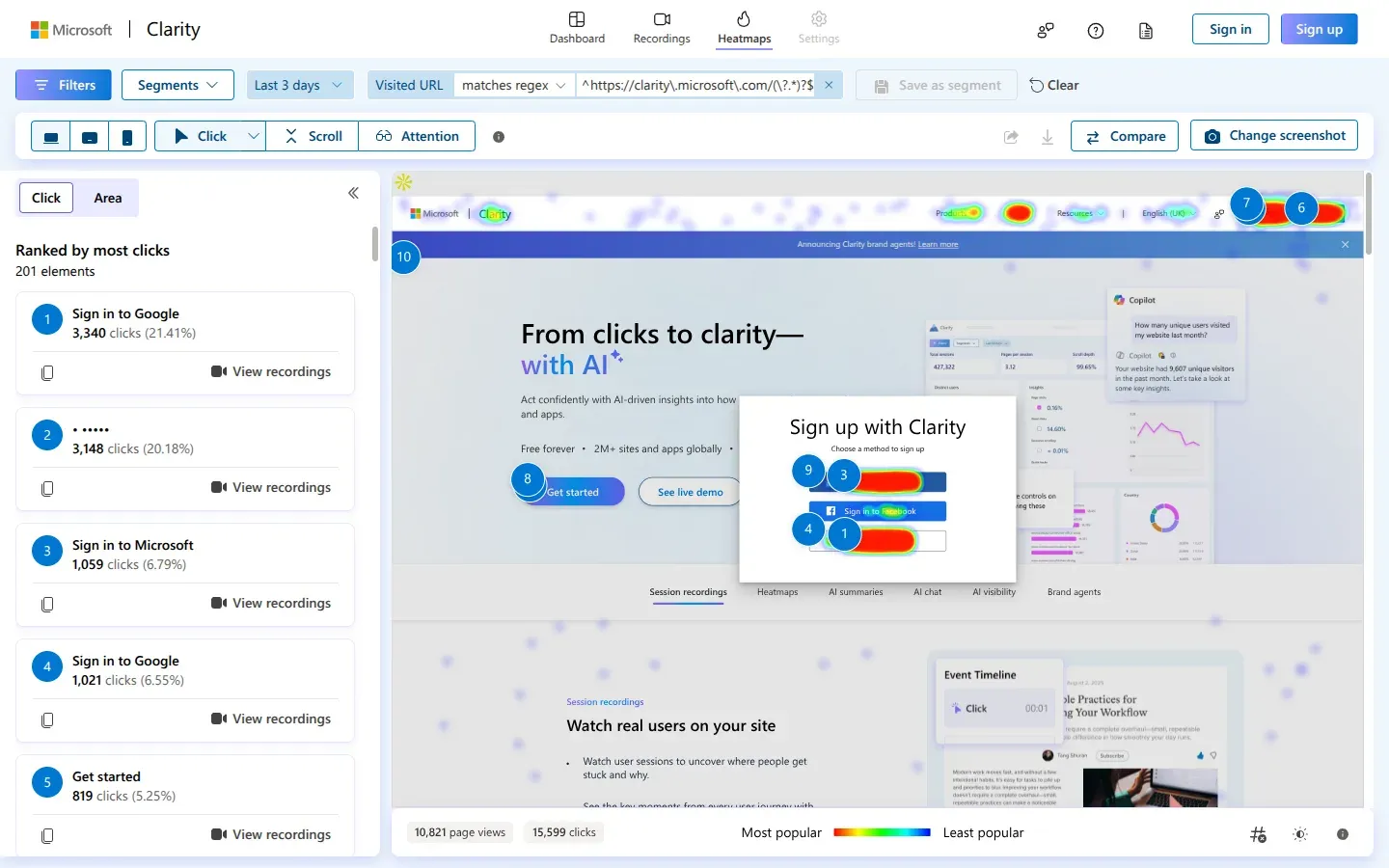
This is the evidence layer in practice — a click heatmap with every element ranked by clicks (Clarity’s public demo project, captured July 12, 2026). You can open this exact demo yourself before installing anything.
Microsoft Clarity — the default first install
Clarity is the whole product for free: heatmaps, session recordings, rage-click detection, AI summaries, with no traffic limits. The real trade-off is 30-day data retention. It’s the first thing to install on any site doing conversion work, because the price of finding out where users struggle should be zero. Microsoft funds it as a data play; you benefit either way.
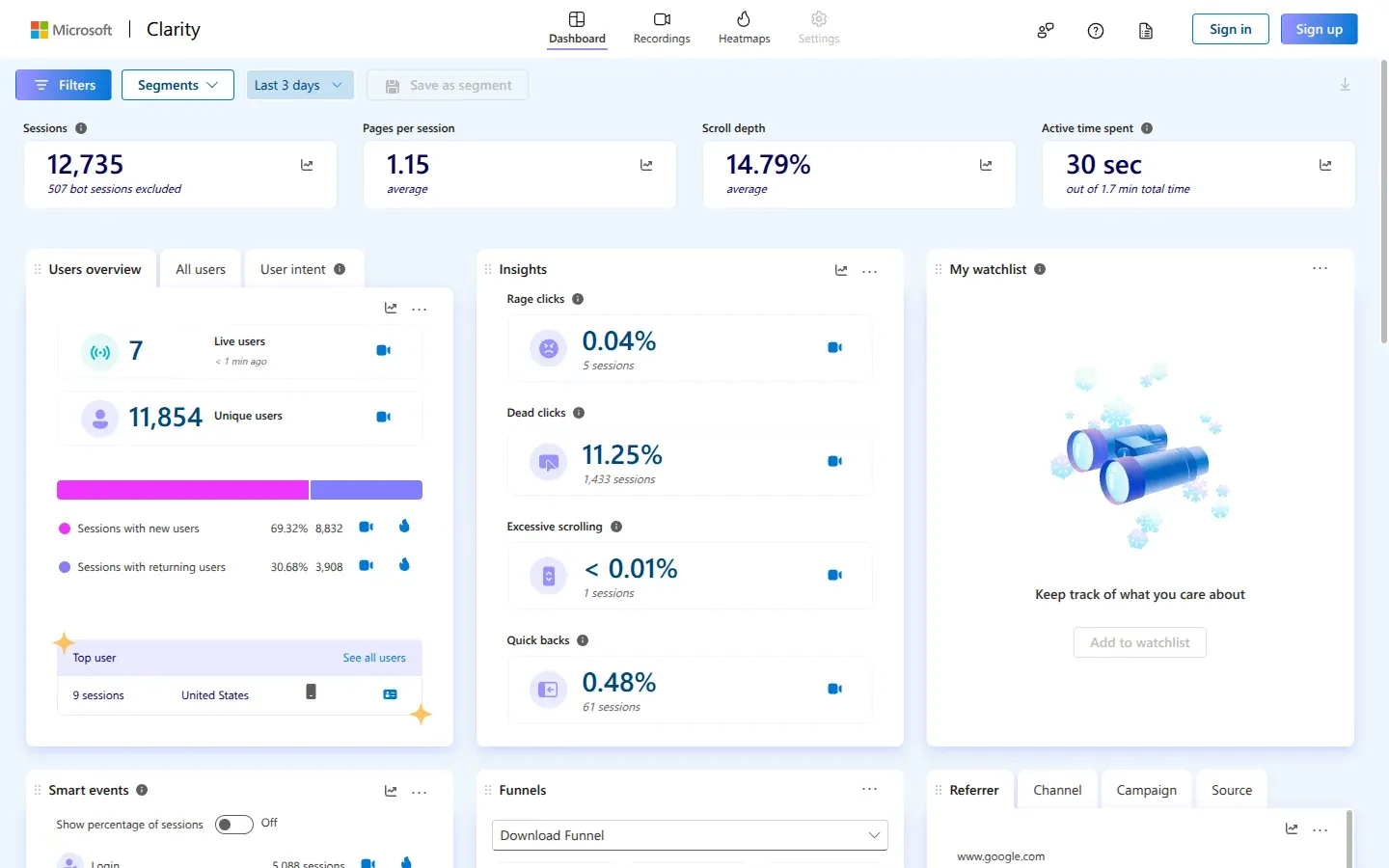
Clarity’s dashboard quantifies frustration for free: rage clicks, dead clicks, and quick-backs, each with the session count behind it (public demo project, captured July 12, 2026).
Pricing (checked July 2026): free, no paid tier at all.
Contentsquare — Hotjar’s successor, surprisingly generous
If you’re looking for Hotjar, this is where it went. The free Experience Analytics plan covers up to 200,000 monthly sessions — the most generous free heatmap tier on the market — with paid plans from $39/mo annually. The catch: the old Hotjar product is now three separately billed modules (analytics, surveys, product analytics), so the all-in price climbs fast if you want everything the old single subscription had.
Who it’s for: teams that outgrew Clarity’s 30-day retention. Who it isn’t for: anyone budgeting off a pre-2025 Hotjar price — those plans no longer exist.
FullStory — session replay for product teams
FullStory is deeper than a heatmap tool — full session analytics with search across every interaction. Its free tier got dramatically better in August 2025: 30,000 sessions a month, ten seats, a year of retention. Paid plans are quote-only, and real contracts run five figures a year, which is why we’d start on the free tier and let the data argue for the upgrade.
Crazy Egg, Lucky Orange, Mouseflow — the smaller heatmap field
Crazy Egg ($29/mo billed annually, no free tier) is the veteran — simple scroll and click reports, metered by pageviews rather than sessions. Lucky Orange ($32/mo annually) bundles recordings with live chat and leans ecommerce; note its long-standing free plan has quietly vanished from the pricing page as of July 2026. Mouseflow ($25/mo annually, 500-session free tier) has the best form analytics of the three — if your problem is a leaky checkout form, it’s the specialist. All three are fine; none beats Clarity’s price of zero for the basics.
A/B testing platforms
The honest preamble every vendor list skips: A/B testing needs traffic. As a working rule, if a page sees fewer than roughly a thousand conversions a month, most tests will take months to reach a trustworthy answer — and your money is better spent on fixing the obvious things first. Tool choice matters less than having enough data to test on.
Convert — the mid-market pick
Convert is what we’d shortlist first for most non-Shopify testing programs: transparent published pricing, privacy-focused, and it bills on tested users — people actually in experiments — rather than all traffic. From $299/mo billed annually including 100,000 tested users a month, 15-day full trial, no free tier. It’s also the rare vendor whose pricing page needed no third-party sources to verify — what it says is what you pay.
VWO and AB Tasty — mid-merger, buy carefully
VWO is a genuinely complete suite — testing, heatmaps, personalization, and a Copilot that generates variations. But two things changed recently: its free plan is being discontinued, and it announced a merger with AB Tasty in January 2026. Its public pricing page no longer shows numbers; third-party checkout data puts entry at approximately $314/mo billed annually. AB Tasty itself is quote-only, no trial, enterprise-shaped.
Our read: both remain good products, but sign short contracts until the merged roadmap is public — consolidations of this size usually mean product overlap gets resolved at the customer’s expense.
Optimizely — enterprise experimentation
Optimizely is the enterprise reference point: full experimentation programs, feature flags, and an AI assistant (Opal) across its whole platform. Everything is quote-only, and its once-free feature-flagging tier has been quietly de-marketed — the sign-up pages now 404. If you’re asking what it costs, it’s built for a bigger program than yours; that’s not a criticism of you or of it.
Shopify-specific testing
Generic A/B tools test what a page says. On Shopify, the levers that move profit are often prices, shipping thresholds, and offers — and two newer tools test those directly.
Intelligems — profit testing, not click testing
Intelligems A/B tests prices, shipping rates, and offers on Shopify — the experiments that change margin, not just conversion rate. From $59/mo billed annually for content tests; price testing starts on the $374/mo plan. It raised a $9M Series A in March 2025 and holds a 4.8-star rating across 160 Shopify App Store reviews. For an ecommerce store, one successful shipping-threshold test can pay for a year of it — run your own numbers on what a margin point is worth.
Shoplift — theme testing without a developer
Shoplift is Shopify-native A/B testing at the theme and template level, from $74/mo billed annually, 4.9 stars across 127 reviews, and the first CRO tool with Shopify Plus certification. Simpler scope than Intelligems — think layout and template tests rather than price experiments.
The measurement layer
Google Analytics 4 — free, unavoidable, and now the AI-traffic ledger
GA4 is where conversion truth lives: it’s free, it feeds Looker Studio, and as of May 2026 it auto-classifies visits from ChatGPT, Gemini, and other assistants into a dedicated AI Assistant channel — worth having configured correctly just for that. The paid 360 tier is quote-only (current third-party estimates start around $50k a year; the $150k figure still floating around is old Universal Analytics pricing). Is it a CRO tool? Not by itself — it tells you where the leak is, not why. Pair it with Clarity and you have both.
Briefly noted: Heap (now also part of Contentsquare) remains a solid auto-capture product analytics tool with a 10,000-session free tier; if your CRO program is product-led rather than campaign-led, it’s the analytics half worth evaluating.
Three stacks that actually make sense
Starting out — $0/month. GA4 + Microsoft Clarity + Looker Studio. Measurement, session evidence, and reporting for nothing. Most sites should exhaust what this stack reveals before paying anyone.
Growing — roughly $60–$410/month. Add the testing layer once traffic justifies it: Convert ($299/mo annual) for most sites, or Intelligems (from $59/mo) on Shopify; Unbounce Experiment ($112/mo annual) if paid-traffic landing pages are the battleground. Upgrade heatmaps only when Clarity’s 30-day retention becomes the bottleneck.
Scaled — quote-only territory. Optimizely or the merged VWO/AB Tasty entity, FullStory paid tiers, GA4 360. At this level the tools are the cheap part; the expensive part is the program discipline around them — which no tool sells.
Common questions about CRO tools
What is the best CRO tool?
There isn’t one best tool — there’s a best stack for your situation. Free measurement and session evidence (GA4 + Microsoft Clarity) fits everyone; the testing layer depends on platform and traffic: Convert for most sites from $299/mo, Intelligems from $59/mo on Shopify, enterprise suites only when a real experimentation program exists. Anyone naming a single “best CRO tool” is usually selling it.
Are CRO tools worth it?
The free ones are worth it unconditionally — Clarity and GA4 cost nothing and regularly surface problems worth thousands a month. Paid tools are worth it when the math works: a testing tool at $300/mo needs to find one improvement worth more than $3,600 a year, which on meaningful ad spend is a low bar. Below roughly a thousand conversions a month, spend on fixes, not testing software.
How much do CRO tools cost?
As of July 2026: a complete starter stack costs $0 (GA4, Clarity, Looker Studio). Mid-market testing runs $299–$399/mo (Convert — annual vs monthly billing), suites around $314/mo and up (VWO, third-party sourced), Shopify tools $59–$374/mo (Intelligems). Enterprise platforms — Optimizely, AB Tasty, GA4 360 — are quote-only, typically five to six figures a year. Heatmap tools run $25–$39/mo where the free tiers don’t already cover you.
Is Google Analytics a CRO tool?
On its own, no — GA4 measures outcomes; it doesn’t explain behavior or run experiments. It becomes part of a CRO stack when paired with session evidence (Clarity, Contentsquare) that shows why pages underperform and a testing tool that proves fixes. It is, however, the non-negotiable foundation: without trustworthy conversion tracking, every other tool on this list is guessing.
What replaced Google Optimize?
Nothing from Google — Optimize shut down on September 30, 2023, and Google’s own documentation directs users to third-party testing tools that integrate with GA4, naming AB Tasty, Optimizely, and VWO. In practice the mid-market replacement question usually lands on Convert or VWO for general sites and Intelligems or Shoplift on Shopify. Note two of Google’s three named options merged with each other in January 2026.
What is a good conversion rate?
The honest answer is: against your own baseline, higher — cross-site benchmarks mislead because they mix industries, traffic sources, and price points. Ecommerce sites commonly land somewhere between 1% and 3%, but a store with cold social traffic at 1.2% might be outperforming a brand-search-heavy store at 3%. What matters is whether your rate is rising, and whether the economics behind it work — the calculator and our break-even ROAS guide do that math.
Pricing on this page was checked against vendor pricing pages on July 11, 2026, and gets re-checked quarterly. If a number here is stale, the vendor moved it after that date — the direction of drift is usually up.
Next post: How much do Facebook ads cost in 2026?
Want this applied to your numbers?
Everything here comes from campaigns we run every day. A strategy call takes the same thinking to your account — what's working, what's leaking, and what we'd change. No slide deck, no pressure, no obligation.